

-

Binks
SKU: 207-11029
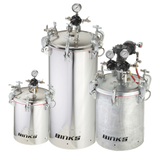
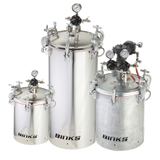
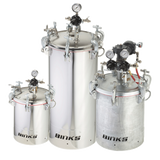
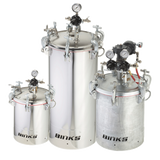
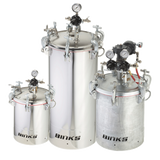
Catalyst Tank C-400-N (207-11029)
$4,684.00*Free Shipping to Continental US* Ships within 24 hours unless backordered
Factory-authorized Binks distributor carrying the complete Binks ASME-code pressure tank lineup — 2-gallon PT Series through 60-gallon production tanks, galvanized and stainless steel, with agitator and bottom-outlet configurations. All tanks built to ASME code and NFPA 33 standards. Ships same-day from Metro Detroit.
Binks has built paint pressure tanks for industrial finishing since 1890, and every tank in the current lineup is manufactured to ASME pressure-vessel code — the standard referenced by NFPA 33, OSHA, your fire marshal, and most commercial insurance underwriters. CET stocks the complete Binks pressure tank catalog: the compact PT Series 2-gallon tanks for small-batch and touch-up work, the 183G galvanized and 183S stainless series in 2-through-15-gallon sizes for general production, and the 30-and-60-gallon tanks for line striping, multi-gun feeds, and high-volume production. Every tank is available with single or double regulation, with or without agitation, in top-outlet or bottom-outlet configurations.
Sizing comes down to three questions: how much coating you spray per shift, whether you're using a plural-component (2K) material with a limited pot life, and what viscosity/chemistry you're spraying. For plural-component work, undersize the tank to match your pot life — buying a 30-gallon tank for a 1-hour pot life material wastes 25 gallons of material every time you mix.
| Your consumption per 8-hr shift | Single-component | Plural-component (1-hr pot life) | Plural-component (4-hr pot life) |
|---|---|---|---|
| Up to 5 gallons | 2 or 5 gallon | 2 gallon | 5 gallon |
| Up to 10 gallons | 10 gallon | 2 gallon | 10 gallon |
| Up to 15 gallons | 15 gallon | 2 gallon | 15 gallon |
| Up to 30 gallons | 30 gallon | 5 gallon | 30 gallon |
| Up to 60 gallons | 60 gallon | 5 gallon | 60 gallon |
|
Interactive Tool
Find your exact Binks pressure tank configurationFilter the complete Binks catalog by material (galvanized/stainless), tank size (2–60 gallon), regulation type, and agitator option. 88 configurations, every part number linked to its product page. |
Open Selector Tool → |
|
ENTRY-LEVEL ASME
PT Series 2-Gallon Tanks (83C / 83Z)The compact entry point to ASME-certified pressure-feed spraying. 2.8-gallon internal volume accepts a 1-gallon pail for easy color changes. Choose 83C zinc-plated lid and shell for solventborne coatings, or 83Z stainless lid / zinc shell for waterborne compatibility. 80 psi max working pressure. Available single or double regulated, with or without direct-drive agitation. Shop PT Series tanks → |
GENERAL INDUSTRIAL
183G ASME Galvanized Carbon SteelThe workhorse industrial pressure tank. Available in 2, 5, 10, and 15 gallon sizes with 110 psi max working pressure. Solvent-compatible galvanized construction, integrated fill port, location-lug lid for proper orientation, and larger carrying handles. Single or double regulation, extra-sensitive regulator option, direct-drive or 15:1 gear-reduced agitator options. Use with optional disposable liner for waterborne coatings. Shop 183G galvanized tanks → |
|
WATERBORNE & CORROSIVE
183S ASME Stainless SteelFull stainless steel construction for maximum corrosion resistance — the right choice for waterborne coatings, high-acid primers, catalyzed polyurethanes, and any application where solventborne residue or rust is a risk. Same 2/5/10/15 gallon sizes, 110 psi max, same regulator and agitator configurations as the 183G series. Shop 183S stainless tanks → |
HIGH-VOLUME PRODUCTION
30 & 60 Gallon Production TanksLarge-capacity tanks for line striping, multi-gun production feeds, marine coatings, and commercial flooring. Galvanized shell in top-outlet or bottom-outlet configuration, with or without 15:1 gear-reduced agitation. Optional stainless-steel liners convert a galvanized shell into a waterborne-compatible system. Shop 30/60 gallon tanks → |
|
NFPA 33 compliance
NFPA 33 — the National Fire Protection Association's standard for spray application of flammable and combustible materials — requires ASME-certified pressure vessels in commercial spray operations. Your fire marshal, OSHA inspector, and insurance underwriter all reference NFPA 33. A non-ASME pressure pot is a compliance failure waiting to happen.
|
|
OSHA and insurance underwriter expectations
Most commercial insurance policies covering spray operations require ASME-code equipment. A failure report on a non-ASME pressure vessel can void coverage on an entire claim. ASME certification is documented, traceable, and stamped on every Binks tank.
|
|
Pressure rating you can rely on
ASME code requires pressure vessels to be tested to 1.3× their rated working pressure. A 110 psi Binks 183G tank has been tested to 143 psi before leaving the factory. Commodity pressure pots without ASME certification typically have no documented test regimen at all.
|
|
Material traceability
ASME-code manufacturing requires documented material certifications, weld qualifications, and inspector stamping. If a Binks tank needs service or warranty review years later, the material documentation is available. Non-ASME tanks have no such records.
|
| Feature | 83C PT Series | 83Z PT Series | 183G Galv. | 183S Stainless | 30/60 Gal | 30/60 SS-Lined |
|---|---|---|---|---|---|---|
| Max working pressure | 80 psi | 80 psi | 110 psi | 110 psi | 110 psi | 110 psi |
| Sizes available | 2 gal | 2 gal | 2, 5, 10, 15 | 2, 5, 10, 15 | 30, 60 | 30, 60 |
| Waterborne compatible | No | Yes (w/ liner) | Yes (w/ liner) | Yes | No | Yes |
| Corrosion resistance | Good | Better | Better | Best | Better | Best |
| Includes fill port | — | — | Yes | Yes | Yes | Yes |
| Bottom outlet available | — | — | Yes | Yes | Yes | Yes |
| Agitator options | Direct drive | Direct drive | Direct or 15:1 gear | Direct or 15:1 gear | 15:1 gear | 15:1 gear |
| Regulation type | Pressure range | Best for |
|---|---|---|
| Single regulated | 0–100 psi | Long runs of single-viscosity material |
| Double regulated | 0–100 psi fluid + 0–60 psi atomizing | Better control of fluid AND atomizing air |
| Single w/ extra-sensitive regulator | 0–30 psi | Short runs of low-viscosity material |
| Double w/ extra-sensitive regulator | 0–30 psi fluid + 0–60 psi atomizing | Low-viscosity with atomizing air control |
| Agitator | Best for |
|---|---|
| None | Coatings that stay well-dispersed; stable solvent-based products |
| Direct drive | Low-viscosity materials, smaller volumes |
| 15:1 gear reduced | High-viscosity materials, larger volumes, waterborne, plural-component, or any material with air entrainment risk |
Bottom outlet kits (183-3000 for 2-gal, 183-3001 for 5/10/15 gal, 83-4229/83-4230 for 30/60 gal) convert top-outlet tanks for high-viscosity materials or easier drain/cleanup at the end of a run.
Air control assemblies (85-470 through 85-493) replace or upgrade regulation setups on 183G/183S tanks. The 85-469 single-to-double regulator conversion kit field-upgrades any 183G or 183S single-regulated tank to double regulation without replacing the tank.
Solvent Saver Tank (183-GZ-5200) is a 2-gallon tank that injects air into the solvent flush stream, reducing solvent consumption dramatically on color changes. Most shops running multiple colors per day recover the tank cost within 6–12 months on solvent savings alone.
Fluid All™ and Ergoflex™ hoses (71-3303 fluid, 71-31101 air) in 3/8" ID, 25 ft lengths — compatible with solventborne and waterborne coatings.
Disposable liners (PT-78-K60 for 2-gal PT; PTL-408-K20 for 5-gal; PTL-412-K8 for 10-gal; PTL-415-K10 for 15-gal) eliminate cleanup between color changes.
Stainless steel liners for 30/60 gal galvanized shells — 83-1569 (30 gal top outlet), 83-1581 (60 gal top outlet), 83-2230 (30 gal bottom outlet), 83-2229 (60 gal bottom outlet) — convert a galvanized shell into a waterborne-compatible system.
|
Factory-authorized distributor
Every tank, regulator, agitator, and wear part is genuine Binks, backed by manufacturer warranty. Binks since 1890; CET for 30+ years.
|
ASME documentation
Every tank ships with its ASME certification documentation. If OSHA or your fire marshal ever asks for paperwork, it's in the crate.
|
Same-day shipping
Orders by 2 PM ET ship the same business day from our Metro Detroit warehouse. Tanks, agitators, regulators, full accessories in stock.
|
Industrial expertise
Straight answers on sizing, plural-component configs, agitator selection, and bottom-outlet setups. 30+ years in finishing.
|
Tank sizing, agitator selection, and ASME compliance questions get confusing fast — especially for plural-component materials or mixed solventborne/waterborne operations. Our team has been configuring Binks pressure tanks for industrial coating lines since 1993.
(586) 210-0555 Email sales@cetinc.com
Binks
SKU: 207-11029