Description
C.A. Technologies · Air Assist Airless · Authorized Distributor
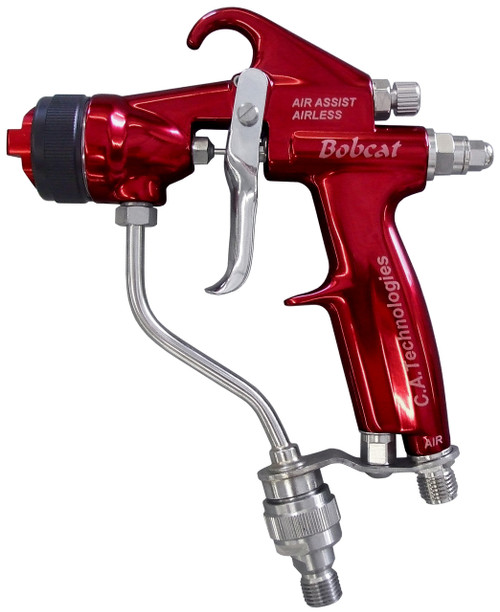
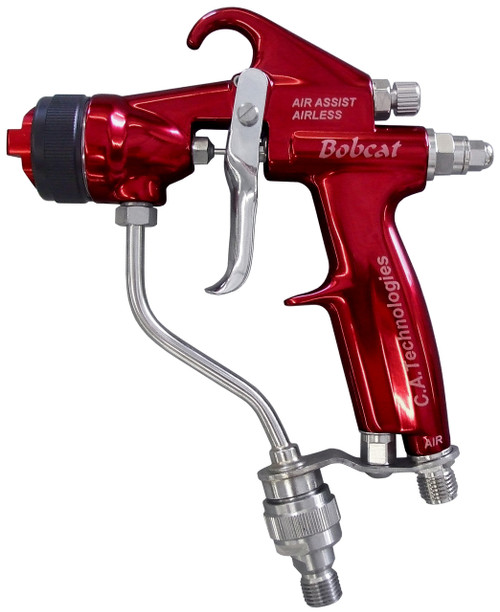
Bobcat B213
0.013” Tip · 20° Spray Angle · 4” Pattern
Air Assist Airless · Tight Spaces, Detail Work & Narrow Substrates · US Made
| Need help selecting the right tip for tight spaces or detail work? CET’s technical team will confirm the right configuration before you order. | 586-210-0555 sales@cetinc.com |
|
Overview Tightest Fan.
|
Why This Configuration? Precision Coverage
|
Configuration Detail
B213 — At a Glance
|
Fluid Tip 0.013” orifice · 20° angle · ~4” pattern Narrowest 0.013” configuration in the Bobcat lineup — full ~17 oz/min fluid delivery in a tight 4” fan for spindles, narrow profiles, and confined work. Field-replaceable tip. |
Air Cap AAA HVLP air cap · ≤18 PSI at handle Same air cap as all Bobcat configurations. The 20° tip geometry controls the tight 4” fan width — air cap refines atomization independently. |
Gun Type AAA Air Assist Airless · 1500 PSI max Requires AAA pump (e.g., Peak 14:1). Airless fluid pressure provides primary atomization; HVLP air at cap refines the pattern. |
|
Technical Data Key Specifications
|
Application Match CET Application GuideMaterial Viscosity Range
|
All Configurations
Find the Right Bobcat Setup
All 26 Bobcat configurations are CET Verified. Gun part number = B + tip code. Click any model or tip to view the full product page.
| Gun | Tip | Orifice | Angle | Pattern | Best For |
|---|---|---|---|---|---|
| 20° — 4” Pattern | |||||
| B211 | 36-211 | 0.011” | 20° | 4” | Tight spaces, fine coatings, 0.011” at 4” |
| B213 ← | 36-213 | 0.013” | 20° | 4” | Tight spaces, narrow profiles & confined areas |
| 30° — 6” Pattern | |||||
| B311 | 36-311 | 0.011” | 30° | 6” | Fine lacquers, enamels, narrow profiles |
| B313 | 36-313 | 0.013” | 30° | 6” | Medium production, narrow components |
| 40° — 8” Pattern | |||||
| B407 | 36-407 | 0.007” | 40° | 8” | Ultra-thin fluids, minimum delivery |
| B409 | 36-409 | 0.009” | 40° | 8” | Thin sealers, stains, fine waterborne |
| B411 | 36-411 | 0.011” | 40° | 8” | Fine lacquers, enamels, waterborne topcoats |
| B413 | 36-413 | 0.013” | 40° | 8” | Most popular — medium production coatings |
| B415 | 36-415 | 0.015” | 40° | 8” | Primers, industrial coatings, higher output |
| B417 | 36-417 | 0.017” | 40° | 8” | Heavy primers, high solid coatings |
| B419 | 36-419 | 0.019” | 40° | 8” | Very heavy materials, high volume |
| 50° — 10” Pattern | |||||
| B509 | 36-509 | 0.009” | 50° | 10” | Thin materials, wider 10” fan |
| B511 | 36-511 | 0.011” | 50° | 10” | Fine lacquers, enamels, wide panel coverage |
| B513 | 36-513 | 0.013” | 50° | 10” | Medium production, wider panel coverage |
| B515 | 36-515 | 0.015” | 50° | 10” | High output, wide panel production |
| B517 | 36-517 | 0.017” | 50° | 10” | Heavy materials, wide coverage |
| 60° — 12” Pattern | |||||
| B611 | 36-611 | 0.011” | 60° | 12” | Large panels, fine materials |
| B613 | 36-613 | 0.013” | 60° | 12” | Large flat panel production |
| B615 | 36-615 | 0.015” | 60° | 12” | Large panels, high output |
| B619 | 36-619 | 0.019” | 60° | 12” | Heavy materials, large panel coverage |
| B621 | 36-621 | 0.021” | 60° | 12” | Maximum output, thickest materials |
| 70° — 14” Pattern | |||||
| B711 | 36-711 | 0.011” | 70° | 14” | Large flat surfaces, fine materials |
| B715 | 36-715 | 0.015” | 70° | 14” | Very wide coverage, large flat surfaces |
| B717 | 36-717 | 0.017” | 70° | 14” | Heavy materials, maximum width |
| B719 | 36-719 | 0.019” | 70° | 14” | Very heavy, wide coverage production |
| B721 | 36-721 | 0.021” | 70° | 14” | Maximum output & width, thickest materials |
Common Questions
Frequently Asked Questions
|
When do I need a 4” pattern instead of 6” or 8”? When your substrate is narrow enough that a wider fan oversprays the target on every pass — chair and table legs, spindles, balusters, metal tube and pipe, angle iron, and interior corners where a wider fan bounces back off adjacent surfaces. The 4” B213 is also the right choice when confined spray environments physically restrict a wider angle. |
Does the 20° angle affect fluid delivery or pressure? No — the 20° angle only controls fan width, not fluid delivery. The B213 delivers the same ~17 oz/min at 1000 PSI as the B313 and B413 because all three use the same 0.013” orifice. Atomization quality and pressure requirements are also unchanged — the angle is purely a geometric property of the tip, not a fluid dynamics variable. |
|
Can I use fan control to narrow the B413 to 4” instead? The fan control knob can narrow the pattern, but it works by restricting air flow to the pattern-shaping horns — which can reduce atomization quality at the pattern edges and create an uneven fan. For consistent narrow work on spindles and legs, a 20° tip that naturally produces a 4” pattern is the correct approach. Call or text 586-210-0555 to confirm the right setup. |
|
|
Where can I find the Bobcat parts manual? The full parts manual with exploded diagram, tip flow chart, and all replacement part numbers is available via the download button below. CET includes documentation with every order. |
Bobcat Air Assist Airless — Parts ManualFull exploded diagram, tip flow chart, air consumption data & all replacement part numbers for the Bobcat AAA spray gun. |
↓ Download Manual |
Not sure whether the B213’s 4” pattern is right for your substrate, or whether you need a wider angle? Contact CET’s technical team — we’ll confirm the right spray angle for your part geometry before you order. Based on over 20 years of industrial finishing equipment experience. — 586-210-0555 · sales@cetinc.com